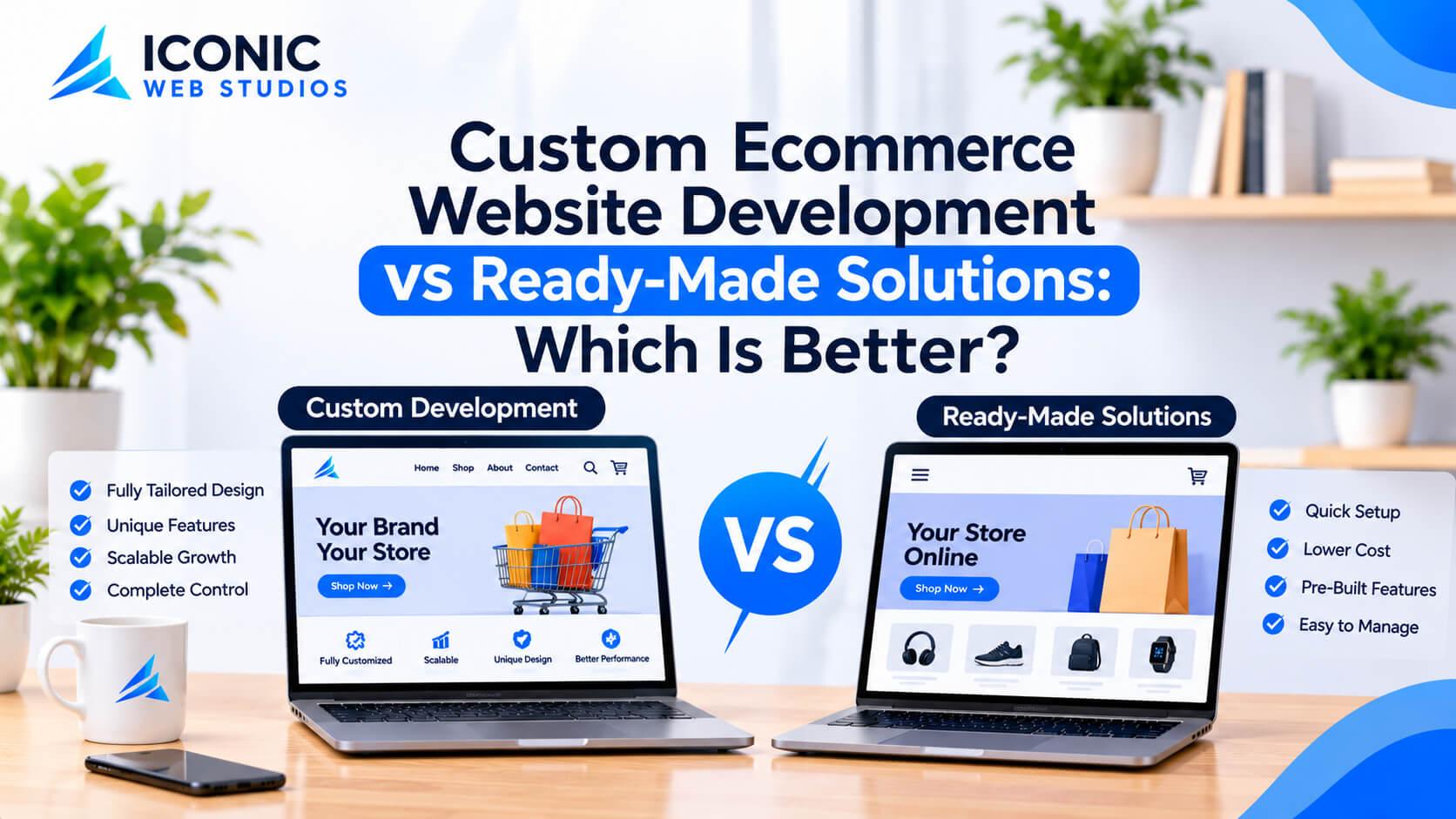
You have a great product and you are ready to sell online. Now comes a big question: should you use a ready-made platform like Shopify, or invest in custom ecommerce website development?
Both options can work well. The right answer depends on your budget, your goals and how fast you want to grow. In this guide, we explain each option in simple words, compare them side by side and help you decide.
What Is a Ready-Made Ecommerce Solution?
A ready-made solution is a platform with a store already built for you. You pick a theme, add products, connect payments and launch. Popular examples include Shopify, WooCommerce, BigCommerce and Wix.
Why people like it:
- Quick to launch (days or weeks)
- Lower upfront cost
- Easy to manage without coding
- Built-in hosting, security and updates (on hosted platforms)
- Large app and plugin library
Where it can fall short:
- Design and features are limited by the platform
- Too many apps can slow down your store
- Monthly fees and app costs add up over time
- Hard to build very unique customer experiences
- You depend on the platform's rules and pricing
What Is Custom Ecommerce Website Development?
Custom development means your store is planned and built around your exact business needs. A developer team designs the layout, writes the code and builds the features you want, instead of fitting your business into a template.
Custom does not always mean "from zero." Many custom stores are built on a strong base such as WooCommerce, Magento or a headless setup, then extended with special features.
Why businesses choose it:
- Unique design and brand experience
- Features made exactly for your process
- Better speed when built with clean code
- Flexible connections with ERP, CRM, inventory and other systems
- Room to grow without hitting platform limits
- Full control of your data and technology
Where it can be harder:
- Higher starting cost
- Takes longer to build
- Needs a skilled team for build and maintenance
- Poor planning can lead to wasted money
Side-by-Side Comparison
| Factor | Ready-Made | Custom |
|---|---|---|
| Starting cost | Low | Higher |
| Launch time | Days to weeks | Weeks to months |
| Design freedom | Limited by theme | Almost unlimited |
| Special features | Needs apps or workarounds | Built exactly to your needs |
| Speed | Can slow down with many apps | Can be highly optimized |
| Scalability | Good up to a point | Strong, built for growth |
| Integrations | Depends on available apps | Any system can be connected |
| Ongoing costs | Subscription and app fees | Hosting and maintenance |
| Technical skill needed | Low | Needs a development team |
| Ownership and control | Limited | Full |
When a Ready-Made Solution Is the Better Choice
Ready-made platforms are a smart pick if:
- You are just starting and want to test your idea
- You have a small number of products
- Your budget is limited
- You want to launch fast
- Your business model is simple (normal product, normal checkout)
- You do not need special features
For many new stores, this is the safest path. You can begin small, learn what customers want and upgrade later.
When Custom Ecommerce Website Development Is the Better Choice
Consider going custom if:
- You need features that no app or theme provides
- You sell complex products (for example, made-to-order or configurable items)
- You need wholesale, B2B pricing or multiple user roles
- You must connect the store to ERP, CRM, warehouse or delivery systems
- Your store is getting slow with too many plugins
- You want a unique brand experience that stands out
- You are growing fast and expect high traffic
- You want long-term control without platform limits
If this sounds like your business, working with a team that provides custom ecommerce development can save you from costly limitations later.
The Cost Question
People often assume custom is "too expensive" and ready-made is "cheap." The real picture is more balanced.
Ready-made: Lower setup cost, but ongoing fees can grow through monthly plans, paid apps, premium themes and transaction fees.
Custom: Higher upfront investment, but fewer recurring app fees and no feature limits. Over several years, the total cost can be competitive, especially for stores with complex needs.
For real numbers, see our guide on ecommerce website development cost in 2026.
Speed, SEO and User Experience
Page speed affects both rankings and sales. Shoppers leave slow stores quickly.
- Ready-made stores can be fast, but each extra app or heavy theme can add weight.
- Custom stores can be built lean, loading only what is needed, which helps with speed and SEO.
Custom also lets you fine-tune the shopping journey: search, filters, checkout steps and mobile layout. Small improvements here can raise your conversion rate. Learn more in our guide to Core Web Vitals and page speed.
Security and Maintenance
Hosted ready-made platforms handle much of the security and updates for you, which is a big plus for small teams.
With custom builds, security depends on your development team. That is why choosing a reliable partner matters. A professional team will use secure coding, safe payment setups, regular backups and ongoing updates.
The Middle Path: Start Ready-Made, Go Custom Later
You do not have to decide forever. A common approach is:
- Launch on a ready-made platform to test the market
- Learn what customers like and where the platform limits you
- Add custom features or move to a custom build when growth demands it
Plan ahead so that moving later is smooth. Keep your product data, URLs and SEO structure in good shape so you do not lose rankings during a move.
Quick Decision Guide
Ask yourself these questions:
- Do I need to launch within a few weeks? → Ready-made
- Is my budget very tight right now? → Ready-made
- Do I need special features or complex integrations? → Custom
- Am I planning to scale quickly or sell in multiple markets? → Custom
- Is my current store slow, messy or limited? → Consider custom
- Am I unsure? → Talk to an expert before you spend
Mistakes to Avoid
- Choosing custom just because it sounds "premium"
- Choosing ready-made without checking its limits
- Installing too many apps and slowing the store
- Skipping planning and requirements
- Picking the cheapest developer without checking experience
- Ignoring mobile users
- Forgetting post-launch support
If you are unsure who to trust with the build, read how to choose the best ecommerce website development company and what to look for when hiring an ecommerce agency.
How Iconic Web Studios Can Help
Whether you need a polished store on a popular platform or a fully tailored build, our ecommerce development services are designed around your goals, not a one-size-fits-all package. We help you compare options honestly and build what truly fits your business.
Conclusion
There is no single winner in the debate of custom vs ready-made. Custom ecommerce website development is ideal for businesses that need unique features, deep integrations and strong long-term growth. Ready-made solutions are great for quick launches, small budgets and simple stores.
The best choice is the one that matches where your business is today and where you want it to be tomorrow. If you want expert guidance, explore our professional ecommerce website development services and get a free consultation.